Showing posts with label fermentation. Show all posts

Wednesday, October 3, 2012

Making Homemade Fruit Vinegar

I had to struggle with this concept for awhile before I decided to try it.  Vinegar's so cheap and easy to pick up, but I'm always thinking along the lines of, "What if I couldn't get any vinegar?"  Say you're running short of cash, or some disaster happens - what are you going to do?  So here's another experiment just for the "Does it really work?!?" factor. 

I recently saw on a video post a woman was using the skins from her pineapple to make vinegar, so I decided to do a little bit of research.  Some recipes were a little vague, but I found this one to be quite useful, so I decided to run with it.

Here's the pineapple I started with when I made the pineapple vodka mix, and it was super ripe.

Once I had cut up the meat, I had the skins and top left over, so I began to cut up the pieces and pack them into a half gallon sized mason jar.  There's actually a couple of tricks to this method: if you leave more meat on the peel, it'll stay near the bottom of the jar.  If you're like me and you want to get as much of the meat into something else, those peels are going to be lighter, so place the lighter stuff at the bottom of the jar, and your heavier pieces at the top to keep everything from floating.

I used filtered water and added a half cup of sugar to the water and peels.  At this point, your instinct is to put a lid on the jar.  NOPE...you're going to take advantage of the fermentation process, which means you need a fabric cover.

I used three layers of cheese cloth and used a rubber band around the neck to keep out any pesky bugs.  The mixture needs to breathe, so if you put a cover on, it can't.  Put it in a dark place and stir it once a day to incorporate oxygen into the brew.  Just be careful and remember there's no lid, so don't tip it in a quick grabbing motion or you'll be wearing a nasty brew!

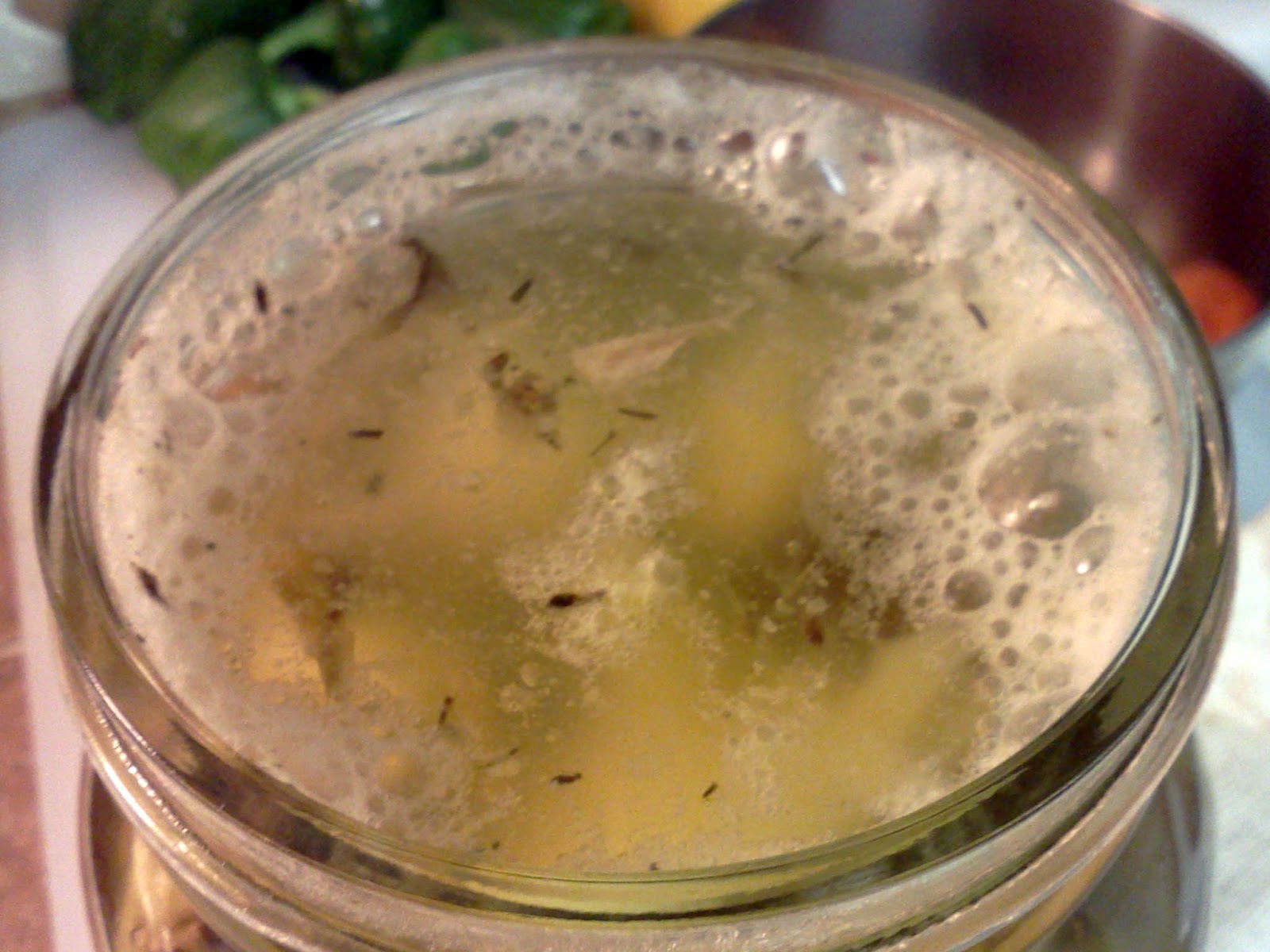
You also need to realize this stuff is going to look like it's rotting in the jar, and it'll turn color before it clears back up again, so don't give up on the mix too soon!

Happy Eats! 

UPDATE:
Here's what the jar looks like after around 30 hours sitting in the cabinet when I took it out to stir and incorporate air in.  It's definitely starting to have a bit of a vinegary scent, but still overwhelmingly the pineapple does make itself known.  Yes, it's supposed to have the nasty foam on the top as it's part of the process, so don't freak when you start seeing it on your jar. 

Making Pineapple Vodka

I bought a pineapple about five weeks ago, and left it out in the window box above the kitchen sink for nearly three weeks.  Fred cut it up for me one morning, and it was obvious at the time that it fermented because it had a strong taste of alcohol.  At the time, I said I was going to head out that day and get a fresh pineapple to repeat the process for pineapple vodka.

 Here she is...ain't she a beauty?  :)  She's been aged in the railing of the deck and in the kitchen window box, and it's so ripe, you can smell it's on the verge of fermenting in its own skin.

I cut up the pineapple and threw the skins and core in a bowl as I have plans for those.  The pineapple is in a half gallon jar, and as you can see, it's even a little bit loose, which is ok since you'll be filling it up with vodka.  Here's a trick - use a cutting board with a groove around the edges.  When the board gets saturated with pineapple juice, simply tip the board over the glass jar and pour the juice in, and you wind up with no waste and very little mess.

I'll confess that I bought cheap vodka this time around from a local distillery, so maybe that's why it was cheap, but since I'm into buying local, I figured it'd give it a try.  If I hadn't poured in every last bit of pineapple juice, I'm sure the last 4 ounces of vodka would've made it easily into the jar.

Tighten the lid well or you'll have the CO2 gas escaping, which you don't want to have happen at this time.  You want it to gas (means it's fermenting), but you MUST crack the jars open every day in the beginning to allow the gas to escape.  If you don't, the lids will buckle and the jar will burst...and all your vodka will go all over the place, and you're out time and cash.  Once the fermentation is going hot and heavy (lots of bubbles in the jar), I move it from a warm location to the fridge to slow the fermentation down; don't worry, it doesn't stop fermenting in a cold environment.  Once you move the jars into the fridge, "burp" the jars every other day for the first two weeks, then you can start backing off to every two days.  You have to keep an eye on the lid - if it's bowed and it's before the "burp", go ahead and crack it open and release the gas.

You want to seal the jars back up tight because you don't want to expose it to air very long or it'll taste like vinegar.  Oh, and it DOES matter what kind of jar you use; mason jars with lids will allow you a much tighter seal to hold in the gas.  Now you might think it's ok to use a plastic bottle or an old salsa jar; your vodka will taste like vinegar if you do because they're not airtight containers.   


And here's the bottled product!  Typically I leave my brews out in a sunny locale so it gets warm and helps get the fermentation process started.  I figure it doesn't really matter too much about the quality of the vodka at this stage as in a year it'll have a great pineapple taste (and when I get back to work in a few days, I'll buy some good stuff and put it away for year when I do this again).

Yes, I let my brews age a solid year, but you don't have to.  Why go through the trouble of aging your mixture?  Well, if you do, then the alcohol has time to develop flavor and character; it's akin to a really good sipping alcohol you want to savor, not slam back shots with.  You really begin to cherish it as "the good stuff"!  

If you chose to ignore my suggestion about the jars and used whatever kind of container you had on hand, skip the fermenting process and just toss it in a dark cabinet and shake it once a day over a 4-6 week time frame.  Pull out the fruit, drain, strain the mix through a coffee filter, and bottle.  Make sure you test your jars first for water leaks as some seals really stink, and you don't want a pineapple vodka "shower" while you're shaking the mixture.

 I never started out to make "homemade hooch"; my goal was to brew extracts for my baking.  To me, I was tired of paying $3-$7 for a bottle of flavoring, and I thought about how vanilla extract was made, so I guessed it'd be the same process with other fruits.  It's not always true, and I suspect my original failures were due to not using mason jars (I ran out of them at the time, and didn't have any clue what I know now), and using frozen, not fresh fruit.  Yes, that does make a big difference from my own experiences...why, I have no idea.

Happy Eats!   :)

Friday, September 21, 2012

Nevermind what color is your parachute, what proof is your pineapple?

I've been playing with fruits and vodka for flavoring extracts as I hate to pay $3.00-$7.00 minimum for as small bottle to flavor cakes, cookies, and other goodies I make.  You could call me cheap, but with the frequency I go through extracts, I'd rather think of myself as crafty and smart.

Last year I failed to make banana as it kept floating to the top of the jar, so the bananas went brown and bad, so I poured that mix down the sink.  Black cherry hasn't done well at all and tastes horrific, and I'd put my apple and mango mixes also into the same category.

The peach and pineapple extracts came out REALLY great because they fermented, which seems to be the key.  The use of them in baked goods almost seems a crime as they're so smooth, you don't taste any alcohol.  So far I've refrained from sipping them, but I have used the peach to make a fuzzy navel jelly that's pretty tasty!

I've learned that fermenting is the key when it comes to making extracts or extra smooth liqueurs.  Today, I had that point reinforced by a green pineapple that had been sitting in the window between 2-3 weeks to ripen up.  Fred pulled it down and sliced it up, and since I was busy doing something else, I didn't take a shameless opportunity to taste test it.
 
This morning, I pulled out a container of my homemade yogurt and tossed in some of those overripe chunks.  Instantly "it" hit me...the taste of the pineapple was quite a bit different than I was used to as it was noticeably boozy!  It had fermented to some degree inside the skin while ripening in the window.  I asked Fred if he could pick up on anything, and he said he had meant to have me taste test the pineapple to see if I tasted the same thing!  Of course we laughed about it with jokes of getting pulled over, driving under the influence of "pineapple" and wondering what "proof" the fruit had become just sitting in the kitchen window.


From time to time around here, I make what I call an "executive decision", and I made another this morning.  I need to go out and find another fresh pineapple, some vodka, and wait 2-3 weeks to make the base of a really GOOD pineapple liqueur.

I can remember as a kid my mom telling me about how bees become more aggressive in the fall because they get "drunk" on fermented fruits on the ground, and when you're picking apples and peaches in the fall, that behavior is very much on display.  I take my time and wander around the fallen fruit on the ground as much as possible to avoid being stung.  Now I've had a great example of boozy fruit, I know exactly how the bees must feel!

My apple extract that's been brewing from underripe apples (which are great for extracting pectin from) isn't cooperating at all.  I suspect the sugars are still firmly locked in the cell walls as the apples look almost as fresh as the day they were picked and peeled.  I even tossed the mason jar in the cooler, wrapped it with a heating pad, and tried to force the apple slices to soften and release their sugars that way.  It bubbled a little bit, but it's far from fermenting.

On the other hand, my prize winning fermentation award goes to the watermellon, which keeps on producing fizz at a rate that would make a shook can of coke seem flat!  I have to "burp" the mason jars a couple of times a week to keep it from bursting the glass from gas build up (it did buckle the lid when I let it go too long).  I'm almost dying to see how well that extract tastes when it's done, and I have no intention of stopping it prematurely just so I can sample it.  I was patient enough to wait 13 months on the others, so I can hold out on round two! 

I also have a strawberry extract fermenting, and just so you know what I'm talking about, here's a short 25 second video to show you: